

How a 401(k) Loan Works: Rules, Costs and Risks
What to know before taking a 401(k) loan
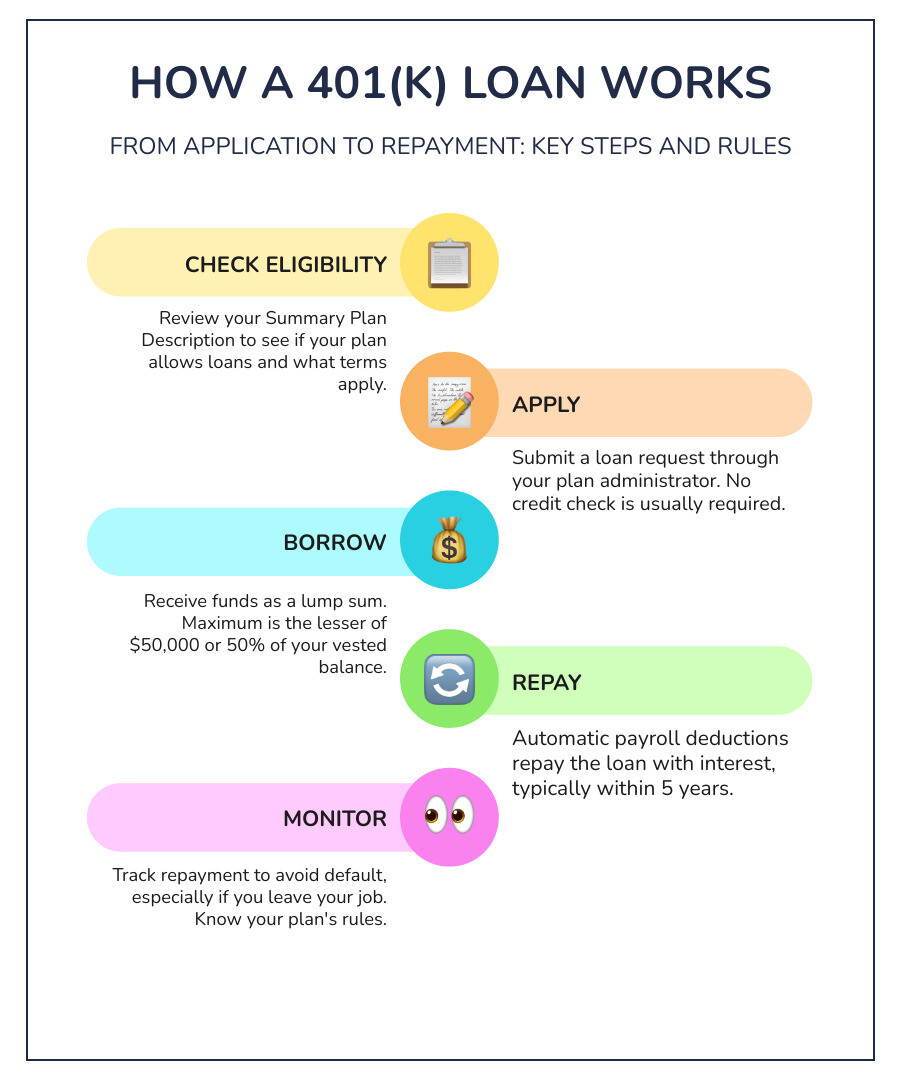
If you’re considering a 401(k) loan, start with your Summary Plan Description—the document that explains your workplace plan’s rules. Not every plan allows loans. If yours does, you can borrow from your retirement account and usually repay through paycheck deductions, with interest going back into your account. The IRS loan rules set borrowing and repayment requirements, but your plan may have additional terms.
A loan can provide cash without an immediate taxable withdrawal. The trade-offs are lost investment growth while the money is out of your account and possible taxes if you don’t repay it. This guide explains the rules, costs, and what may happen if you leave your job.
How a 401(k) loan works: Core rules and borrowing limits
Before tapping your nest egg, you must confirm whether your employer’s plan allows participant borrowing. Employers are not legally required to offer loan provisions. If permitted, the terms are outlined in your plan’s Summary Plan Description (SPD).
When you borrow, the funds come directly out of your existing investments. Repayments—including both principal and interest—are automatically deducted from your after-tax paycheck and credited back to your account. Plans typically charge a one-time loan origination fee, often ranging from $50 to $100, and some may charge ongoing annual maintenance fees between $25 and $50.
How do 401(k) loans work in practice?
The administrative process is generally straightforward. You submit a request through your plan’s online portal or benefits department. Because you are borrowing your own vested money, there is usually no formal credit check or extensive underwriting process.
Understanding the difference between a 401(k) loan and withdrawal is essential. A withdrawal permanently removes capital from your account, triggering immediate income taxes and a potential 10% early distribution penalty if you are under age 59½. In contrast, a loan remains non-taxable as long as you follow the scheduled repayment terms.
IRS 401(k) loan rules and maximum borrowing limits
According to statutory limits outlined by the IRS, the maximum amount you can borrow across all outstanding plan loans is generally the lesser of:
- $50,000, reduced by the highest outstanding loan balance you held during the prior 12-month period, or
- 50% of your vested account balance (or up to $10,000 if your plan allows it and your balance is below $20,000).
General loans must be repaid in substantially equal payments—at least quarterly—over a maximum term of 5 years. If the loan is used to acquire a primary residence, the plan may allow an extended repayment period.
| Vested Account Balance | Maximum Potential Loan Amount | Notes |
|---|---|---|
| $15,000 | $10,000 | If plan includes the $10,000 minimum allowance |
| $40,000 | $20,000 | Capped at 50% of vested balance |
| $100,000 | $50,000 | Capped at 50% of vested balance |
| $150,000 | $50,000 | Capped at the statutory $50,000 maximum limit |
Interest rates are set by the plan and are frequently tied to the prime rate plus 1% to 2%. While paying interest to yourself sounds attractive, borrowing still carries significant financial trade-offs.
The pros, cons, and hidden opportunity costs of borrowing
A plan loan can provide fast liquidity, typically without a hard credit check or impact on your credit profile. However, taking funds out of the market can interfere with long-term wealth accumulation, and borrowing is not without risk.

The can be the real cost: Missed market compounding and double taxation
The primary cost of a retirement loan is the opportunity cost of uninvested assets. When you liquidate shares to fund a loan, those dollars miss out on potential market growth and compounding returns while the loan is outstanding. Investing involves risk of loss, so there is no guarantee that money left invested would have grown, but removing capital does remove the possibility of participating in any market gains during that period.
Additionally, plan loans may create a subtle double-taxation scenario on the interest portion:
- You repay the loan and interest using after-tax dollars deducted from your paycheck.
- When you eventually withdraw those interest earnings in retirement, they are taxed again as ordinary income.
Depending on your plan’s rules, your ability to make new salary deferrals may also be paused while you have an active loan balance. Suspending contributions could mean you also miss out on employer matching contributions during repayment, if your plan allows it. Because the trade-offs vary by plan design, it can help to review your options with a qualified financial or tax professional before deciding.
What happens to your loan if you leave or lose your job?
One of the largest risks of a workplace loan involves changing employers. If you resign, are laid off, or are terminated with an outstanding loan balance, the repayment rules shift quickly.

If you cannot repay the outstanding balance, the plan administrator will execute a plan loan offset. This reduces your remaining account balance by the unpaid amount.
Under the Tax Cuts and Jobs Act (TCJA), if the offset occurs due to job separation or plan termination, it is classified as a Qualified Plan Loan Offset (QPLO). According to IRS guidance on plan loan offsets, you have until the tax filing due date (including extensions) for the tax year in which the offset occurred to roll over the unpaid balance into an IRA or a new eligible employer plan. This provides more time than the standard 60-day rollover window. For a detailed review of this scenario, read about what happens when you leave an employer with an outstanding loan.
Tax consequences and penalties of a defaulted 401(k) loan
If you fail to make payments while still employed, or miss the extended rollover deadline after leaving a job, the unpaid amount is treated as a deemed distribution:
- The remaining balance is reported to the IRS on Form 1099-R as ordinary taxable income.
- If you are under age 59½, an additional 10% early distribution tax may apply, unless you qualify for an IRS exception.
- Defaulted amounts permanently reduce your retirement savings balance.
Common alternatives to raiding your retirement savings
Before borrowing against your future, it can help to consider whether other financing methods may better preserve your long-term retirement savings. Exploring structured debt consolidation options from the National Credit Union Administration or personal financing may allow your retirement investments to remain in the market.
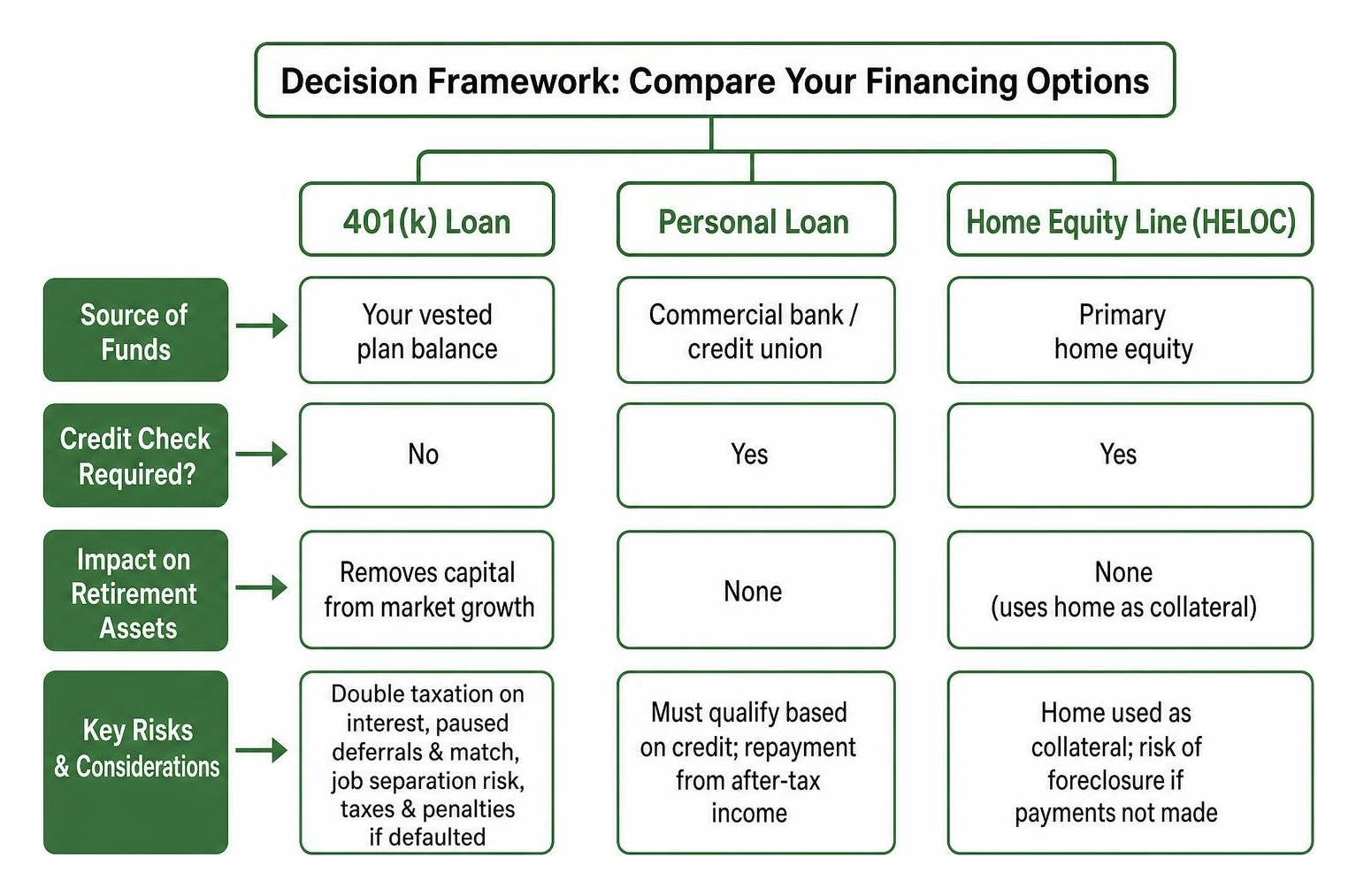
| Financing Option | Source of Funds | Credit Check Required? | Impact on Retirement Assets |
|---|---|---|---|
| 401(k) Loan | Your vested plan balance | No | Removes capital from market growth |
| Personal Loan | Commercial bank / credit union | Yes | None |
| Home Equity Line (HELOC) | Primary home equity | Yes | None (uses home as collateral) |
| Emergency Savings | Cash reserve / bank account | No | None |
Each option carries its own costs, qualification requirements, and trade-offs. A personal loan or home equity line of credit, for example, typically involves a credit check and ongoing interest paid to an outside lender, while emergency savings require having cash already set aside. Comparing these choices against your own situation, and discussing them with a tax or legal professional when needed, can help you make a more informed decision before tapping your workplace plan.
Key takeaways before borrowing from retirement
- Verify plan terms: Always check your Summary Plan Description to confirm if loans are permitted and review any administrative fees.
- Observe statutory caps: Borrowing is legally capped at the lesser of $50,000 or 50% of your vested balance.
- Weigh the opportunity cost: Withdrawn funds miss out on potential market compounding, and loan interest is repaid with after-tax money.
- Plan for job transitions: Leaving an employer accelerates repayment obligations, which may trigger taxes and penalties if not rolled over on time.
- Maintain your contributions: Aim to keep contributing to your plan during repayment so you don’t miss out on potential employer matching funds.
Frequently asked questions about 401(k) loans
Will my employer know if I take a 401(k) loan?
Yes. Because repayments are processed through payroll deductions, your company’s human resources or payroll staff will handle the administrative setup. However, they are not typically provided details regarding why you requested the loan.
Can I use a 401(k) loan for a down payment on a house?
Yes, if your plan allows it. If the loan is used to purchase a primary residence, your plan may offer an extended repayment schedule beyond the standard 5-year limit. Mortgage underwriters will factor the monthly repayment obligation into your overall debt calculations.
Does taking a 401(k) loan hurt my credit score?
A plan loan does not involve a credit check upon application, nor is standard repayment reported to consumer credit bureaus. However, taking a loan could indirectly reduce your take-home pay, which may impact your cash flow for other credit obligations.
Managing a retirement portfolio involves balancing short-term liquidity needs with long-term growth objectives. At 401(k) Maneuver, our independent fiduciary team provides professional account management designed to help you navigate portfolio allocation, risk control, and plan options. To review your strategy, call us at 1-877-218-5060 or learn how professional 401(k) account management works.
Disclosure: This material is for educational and informational purposes only and does not constitute personalized financial, tax, or legal advice. 401(k) Maneuver is a business name of Royal Fund Management, LLC, an SEC-registered investment adviser. Investing involves risk of loss, and past performance does not guarantee future results.