
Choosing a 401(k) Vesting Schedule for Your Company
Choosing a 401(k) vesting schedule for your company
A 401(k) vesting schedule sets when employees gain permanent ownership of employer contributions, such as matching or profit-sharing contributions. Your company may choose immediate vesting (ownership right away), cliff vesting (ownership all at once after a set period), or graded vesting (ownership in steps). Federal rules limit the schedules you can use, while employees always own their own contributions. IRS vesting guidance explains these requirements.
The right choice depends on your hiring and retention goals. A longer schedule may encourage employees to stay, but it can make your benefits less appealing to someone considering a job offer. As you compare options, consider how each schedule affects employees who leave and how clearly you can explain it to your team.
Discover more about 401(k) vesting schedules and review 401(k) eligibility requirements to support your company’s retirement benefit structure.
Understanding 401(k) vesting and account ownership
When designing your company’s retirement plan, understanding 401(k) vesting is a fundamental step. Vesting represents the legal ownership process that determines how much of an account balance an employee keeps upon leaving the company.
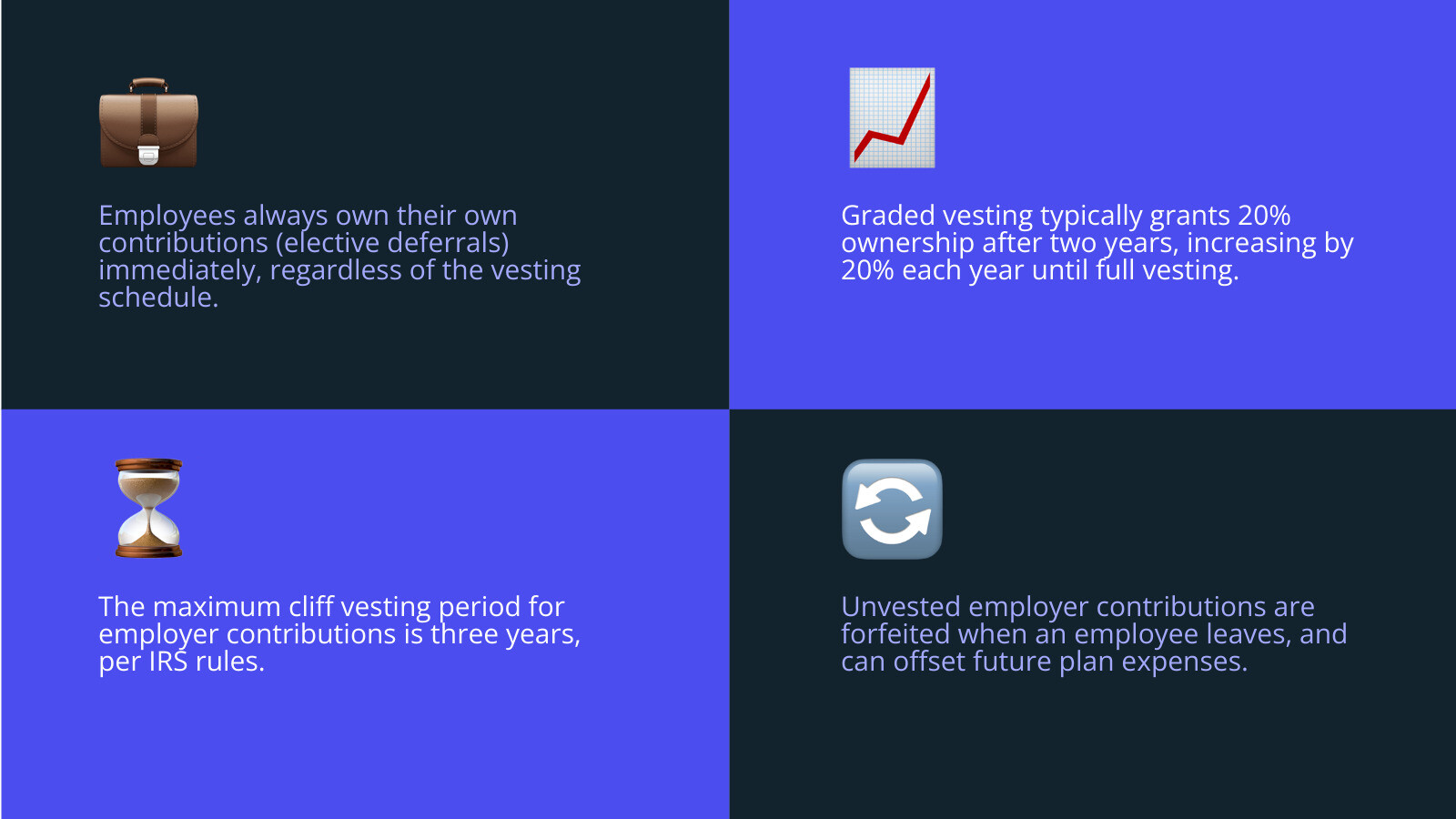
Vesting rules apply strictly to employer-provided dollars. Plan participants always maintain 100% non-forfeitable ownership of their own salary deferrals, rollover balances transferred from prior plans, and the earnings generated by those funds.
How a 401(k) vesting schedule applies to employer contributions
A plan sponsor can attach a vesting schedule to discretionary employer matching contributions and profit-sharing allocations. The schedule dictates what portion of those company dollars an employee owns based on their accumulated service.
Plan documents define how service is measured, commonly using either the hours-of-service method (often requiring 1,000 hours of service during a 12-month calculation period) or the elapsed-time method (measuring total calendar service regardless of hours). Vesting applies to the overall balance of employer contributions rather than each plan year’s deposit individually.
Mandatory immediate vesting vs. schedule-eligible contributions
Not all company contributions can be subject to a delayed timeline. Under federal guidelines, certain plan designs and contribution types require 100% immediate vesting from day one:
- Employee elective deferrals: Pre-tax and designated Roth employee contributions are always 100% vested immediately.
- Rollover contributions: Any assets rolled into the plan from an outside qualified plan or IRA belong entirely to the employee.
- Traditional Safe Harbor contributions: Employer matching or nonelective contributions in standard Safe Harbor plans must vest immediately to satisfy annual non-discrimination testing exemptions.
- SEP and SIMPLE IRA plans: Small employer plans under SIMPLE or SEP structures require immediate 100% vesting of all employer contributions.
- Qualified Automatic Contribution Arrangements (QACA): A specialized safe harbor design that permits up to a 2-year 100% cliff vesting schedule.
- Discretionary match and profit-sharing: Standard employer matches and profit-sharing contributions in non-safe harbor 401(k) plans can follow statutory graded or cliff timelines.
Types of vesting schedules and statutory limits

When selecting a framework for vesting 401(k) dollars, employers generally evaluate three primary models: immediate, cliff, and graded structures.
Immediate, cliff, and graded vesting options
Each structure establishes a different timeline for transferring ownership of employer dollars:
- Immediate vesting: Employees own 100% of employer contributions as soon as they are deposited. This offers a clear recruiting advantage and simplifies administrative recordkeeping.
- Cliff vesting: Employees own 0% of employer contributions for an initial period of service, jumping directly to 100% ownership once they reach the required milestone.
- Graded vesting: Ownership increases incrementally over time (for example, 20% per year starting after the second year), granting partial ownership as tenure increases.
| Vesting Type | Year 1 | Year 2 | Year 3 | Year 4 | Year 5 | Year 6 |
|---|---|---|---|---|---|---|
| Immediate | 100% | 100% | 100% | 100% | 100% | 100% |
| 3-Year Cliff (Statutory Max) | 0% | 0% | 100% | 100% | 100% | 100% |
| 6-Year Graded (Statutory Max) | 0% | 20% | 40% | 60% | 80% | 100% |
| 4-Year Graded Example | 25% | 50% | 75% | 100% | 100% | 100% |
Selecting a 401(k) vesting schedule within IRS legal maximums
Federal law establishes statutory limits on how long an employer can delay full ownership. Under Internal Revenue Code (IRC) §411(a)(2)(B), non-top-heavy defined contribution plans cannot exceed either:
- A 3-year cliff schedule (0% for years 1 and 2; 100% after 3 years of service).
- A 6-year graded schedule (minimum 20% after 2 years, 40% after 3 years, 60% after 4 years, 80% after 5 years, and 100% after 6 years of service).
For plans that are deemed top-heavy—meaning key employees hold more than 60% of total plan assets—the maximum permissible 401(k) vesting period accelerates under IRC §416 to either a 3-year cliff or a 6-year graded schedule with faster milestones (20% starting at year 2).
Strategic factors when designing your 401(k) vesting schedule

Deciding on the appropriate schedule requires balancing compensation goals, administrative practicalities, and workforce retention dynamics.
Balancing employee retention against recruiting attractiveness
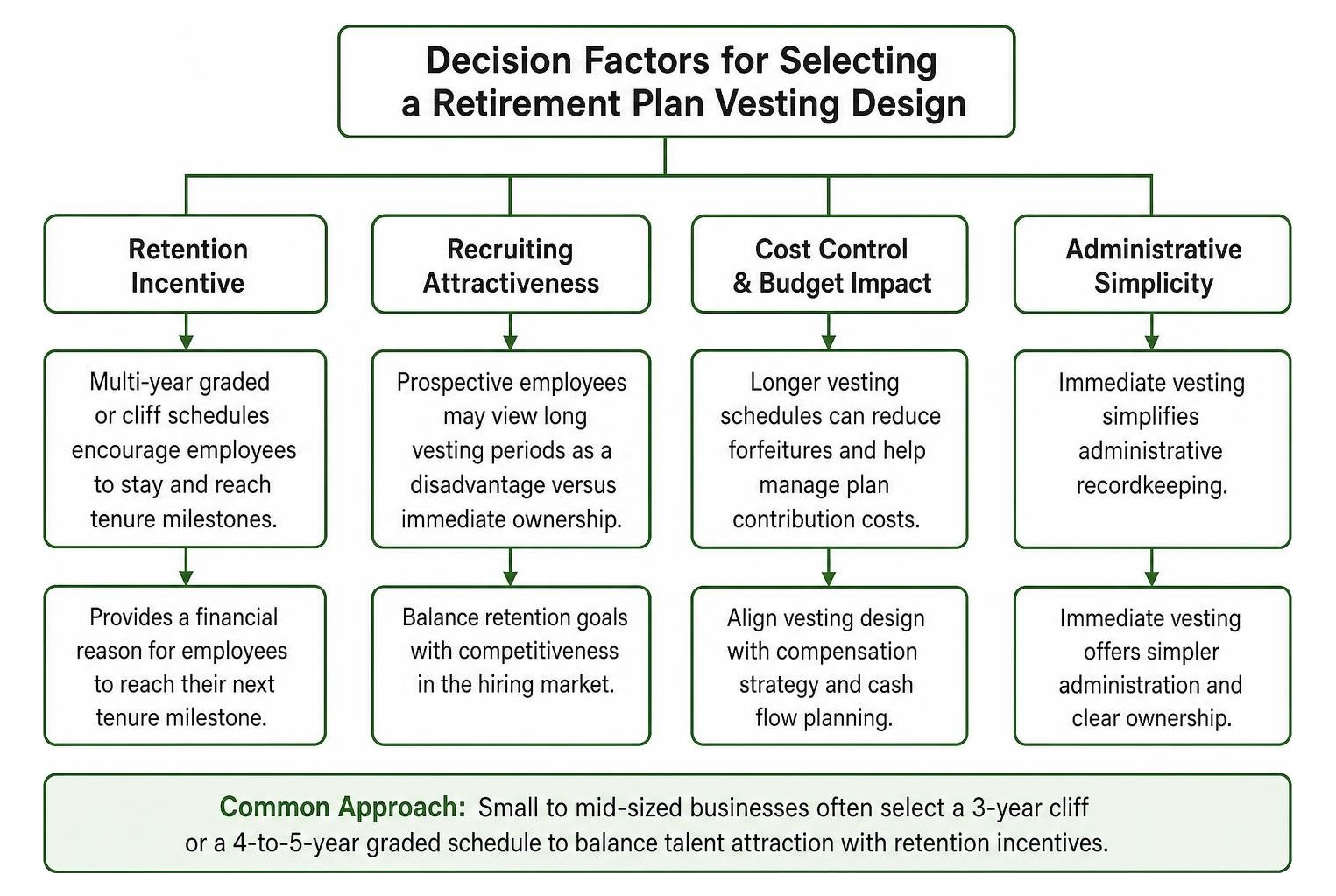
A multi-year graded or cliff schedule can serve as an incentive for staff retention, providing a financial reason for employees to reach their next tenure milestone. However, in competitive hiring environments, prospective employees may view long vesting periods as a drawback compared to competitors offering immediate ownership.
Small to mid-sized businesses often select a 3-year cliff or a 4-to-5-year graded schedule to balance talent attraction with meaningful retention incentives.
Managing plan forfeitures and plan expense offsets
When employees leave a company before becoming fully vested, the non-vested portion of employer contributions remains in the plan’s forfeiture account. Forfeitures can be substantial across employer plans. In 2022, analysis of Form 5500 filings across 909 single-employer 401(k) plans showed that over 1.8 million participants forfeited employer contributions, totaling over $1.5 billion.
Plan sponsors must manage forfeiture accounts strictly according to plan documents and Department of Labor (DOL) fiduciary standards. Permissible uses for forfeited balances typically include:
- Paying legitimate, reasonable plan administrative expenses.
- Offsetting and reducing future employer contribution obligations.
- Reallocating funds to active plan participants as an additional contribution.
Plan administrators must ensure forfeiture balances are utilized within the timeframes specified in the plan document (typically by the end of the plan year following the year the forfeiture occurred) to maintain tax qualification.
Compliance, plan amendments, and employee communications
Maintaining compliance requires adhering to statutory notice rules, participant disclosure mandates, and amendment protections outlined in IRC Section 411 qualified plan requirements.
Anti-cutback rules and accelerated vesting triggers
Under IRC §411(d)(6) anti-cutback regulations, a plan amendment cannot reduce a participant’s previously earned accrued vesting percentage. If an employer amends the plan to adopt a slower schedule, participants with at least three years of service must be allowed to elect to remain under the prior schedule.
Additionally, certain events automatically trigger immediate 100% vesting regardless of the plan’s standard timeline:
- Reaching the plan’s defined normal retirement age while still employed.
- Complete termination of the retirement plan by the sponsor.
- A partial plan termination, which generally occurs under IRS rules when employer-initiated turnover exceeds 20% in an applicable period.
Best practices for communicating vesting rules to employees
Clear communication prevents participant misunderstandings regarding account ownership. Best practices include:
- Distributing the Summary Plan Description (SPD) to new participants within 90 days of enrollment.
- Ensuring participant account portals clearly display vested balances alongside total balances.
- Providing educational materials that explain how service hours and employment anniversaries impact ownership percentages.
Key takeaways for plan sponsors
- Employee money is always 100% vested: Elective deferrals and rollover balances can never be subjected to a vesting schedule.
- Statutory maximums apply: Non-safe harbor plans cannot exceed a 3-year cliff or a 6-year graded schedule under IRC §411.
- Safe Harbor rules differ: Traditional Safe Harbor contributions require immediate full vesting, while QACA arrangements permit up to a 2-year cliff.
- Forfeitures require prudent handling: Unvested assets left by departing employees must be used for plan expenses, employer match offsets, or reallocations within designated time limits.
Frequently asked questions about 401(k) vesting
What is 401(k) vesting and how does it apply to employer contributions?
Vesting is the process by which employees earn ownership of employer-contributed retirement assets over time. While employee deferrals are always 100% owned, employer contributions can require a specific duration of service before becoming fully non-forfeitable.
How long can an employer set a 401(k) vesting period?
For standard discretionary matches or profit-sharing, federal statutory limits cap schedules at a maximum of a 3-year cliff or a 6-year graded schedule. QACA safe harbor plans may use up to a 2-year cliff, while standard Safe Harbor plans require immediate 100% vesting.
What happens to unvested money when an employee leaves?
Unvested funds are forfeited back to the plan account. The plan document dictates whether these balances are used to offset future employer contributions, pay allowable administrative fees, or reallocate to remaining active participants.
Conclusion and next steps for employers
Choosing the right vesting schedule is an important design choice that affects employee recruitment, retention, and ongoing plan costs. Evaluating your company’s turnover patterns and long-term goals will help you identify the most balanced approach for your retirement program.
If you are evaluating your retirement plan design, our team at 401(k) Maneuver works with business owners to navigate plan structures. You can learn how the 401(k) Maneuver pooled employer plan (PEP) works for employers or call us at 1-877-218-5060 to start a conversation about your retirement plan options.
Disclosure: 401(k) Maneuver is a business name of Royal Fund Management, LLC, an SEC-registered investment adviser. This article is intended for educational and informational purposes only and does not constitute individualized legal, tax, or investment advice. Plan sponsors should consult qualified ERISA legal counsel or a certified tax professional regarding specific plan design and compliance questions. Joining a pooled employer plan (PEP) may shift certain administrative and fiduciary duties to the pooled plan provider, but employers retain the fiduciary responsibility to prudently select and monitor service providers and remit participant contributions in a timely manner. Investing involves risk of loss, and past performance is no guarantee of future results.