

401(k) Terms Every Beginner Should Know
401(k) for beginners: The terms that matter
A 401(k) is a workplace retirement account funded through your paycheck. To get started, choose how much to contribute, check whether your employer offers a match, and select investments from your plan’s options. Your plan materials can tell you when employer contributions become yours and what fees you pay.
Terms like vesting, expense ratio, and rebalancing may look unfamiliar. The 401(k) Maneuver team, an independent fiduciary, explains these 401(k) terms in plain English so you can read your account documents and make more informed choices.
Key vocabulary for a 401(k) for beginners includes auto enrollment, beneficiary designations, and enrollment forms.
401(k) for beginners: Contributions and matching

Starting out with a retirement account involves understanding how money moves from your paycheck into your investments. A 401(k) is an employer-sponsored retirement savings plan that allows eligible employees to save and invest a portion of their income.
The money you choose to contribute is processed as an elective deferral, meaning it is automatically deducted from your payroll before you receive your net pay.
Elective deferrals and contribution limits
An elective deferral is the specific dollar amount or percentage of salary you elect to transfer from your paycheck into your 401(k) plan. The Internal Revenue Service (IRS) sets annual maximums on how much you can contribute across all workplace plans.
For the 2026 tax year, the IRS elective deferral limit is $24,500 for employees under age 50. Savers aged 50 and older can make standard catch-up contributions of up to $8,000, bringing their total elective deferral limit to $32,500.
Under the SECURE 2.0 Act, an enhanced catch-up limit of $11,250 is available for participants aged 60 through 63, allowing a total elective deferral of up to $35,750 for the 2026 tax year. The overall combined limit for both employee and employer contributions in 2026 is $72,000 (or $80,000 to $83,250 with eligible catch-up contributions). You can review the full breakdown of annual 401(k) contribution limits and consult the 2026 OIEA Guide on building wealth over time alongside official IRS contribution rules.
Employer match and vesting schedules
An employer match represents additional money your company deposits into your account based on your elective deferrals. A common matching formula is 50% of your contributions up to 6% of your salary, while some employers offer a dollar-for-dollar match up to a designated cap.
If your plan allows it under SECURE 2.0 provisions, some employers also offer matching contributions based on qualified student loan repayments.
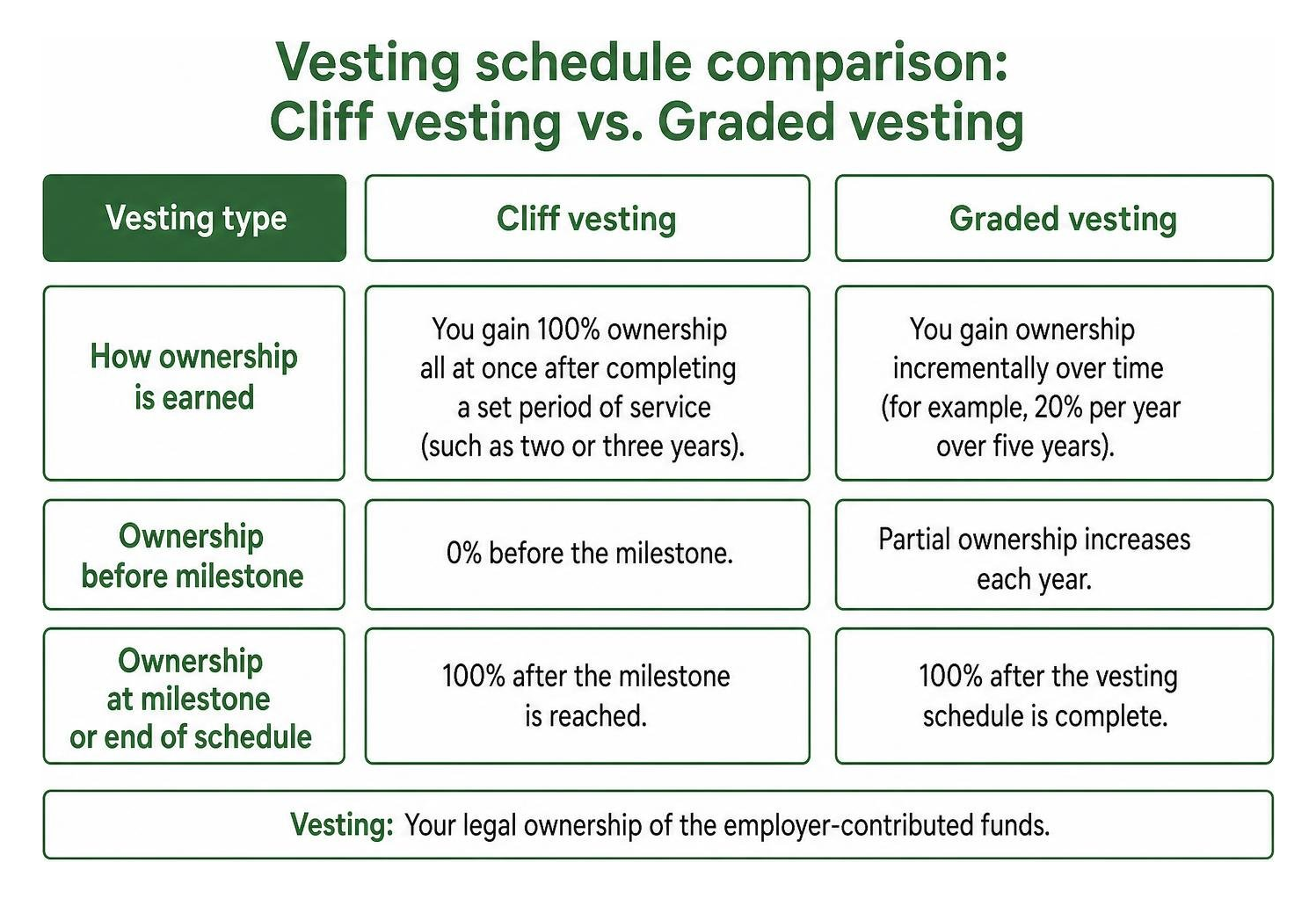
Vesting refers to your legal ownership of the employer-contributed funds:
- Immediate vesting: You own 100% of employer contributions as soon as they are deposited.
- Cliff vesting: You gain 100% ownership all at once after completing a set period of service (such as two or three years), owning 0% before that milestone.
- Graded vesting: You gain ownership incrementally over time (for example, 20% per year over five years).
Your own elective deferrals are always 100% vested immediately. If you leave your job before matching dollars vest, the unvested portion is subject to forfeiture back to the plan. Always check your plan’s Summary Plan Description (SPD) for specific vesting terms.
Tax structures: Traditional vs. Roth accounts
Workplace plans may offer two distinct tax treatments: Traditional pre-tax deferrals and Roth after-tax contributions. Understanding how each impacts your current income taxes and future withdrawals can help you evaluate traditional vs. Roth 401(k) options.
| Feature | Traditional 401(k) | Roth 401(k) |
|---|---|---|
| Contribution Tax Status | Pre-tax dollars | After-tax dollars |
| Upfront Tax Deduction | Yes (reduces current taxable income) | No upfront deduction |
| Growth Treatment | Tax-deferred | Tax-free |
| Qualified Withdrawals | Taxed as ordinary income | 100% tax-free |
| Availability | Standard in almost all plans | If your plan allows it |
Note: Roth 401(k) availability depends on your employer’s plan design. Check your Summary Plan Description for plan-specific details.
Traditional pre-tax deferrals
Traditional contributions are deducted from your gross pay before federal and most state income taxes are calculated. This pre-tax treatment reduces your current-year taxable income, potentially lowering your tax liability today.
The funds grow on a tax-deferred basis, meaning you pay no taxes on investment dividends or capital gains while the money remains in the account. When you take distributions in retirement, withdrawals are taxed as ordinary income at your then-applicable tax rate.
Roth 401(k) after-tax contributions
Roth contributions are deducted after taxes have been withheld from your paycheck, providing no immediate reduction to your taxable income. However, earnings grow tax-free, and qualified distributions in retirement are completely exempt from federal income taxes.
To qualify for tax-free withdrawals, distributions must occur after age 59½ and satisfy the IRS five-year rule (at least five tax years must pass since your first Roth contribution).
Under SECURE 2.0 rules, high earners (those with prior-year FICA wages exceeding the statutory threshold, indexed at $145,000) will eventually be required to direct catch-up contributions exclusively to a Roth account, subject to ongoing IRS administrative transition guidance.
Investment and account 401(k) terms to master

Once funds enter your 401(k), they must be allocated across investment options offered by your plan menu, such as mutual funds, index funds, and bond portfolios.
Target-date funds and QDIAs in a 401(k) for beginners
If you do not manually choose investments upon enrollment, regulations allow your plan sponsor to place your money into a Qualified Default Investment Alternative (QDIA). The most common QDIA is a target-date fund (TDF).
A target-date fund is a diversified mutual fund designed around an anticipated retirement year (e.g., Target Retirement 2055). It follows a predetermined “glide path,” automatically shifting from growth-oriented equities toward more conservative fixed-income assets as you get closer to retirement. You can review investment basics in the SEC investor guide to building wealth.
Expense ratios, administrative fees, and ongoing rebalancing
Every investment fund carries costs that impact your long-term account balance:
- Expense ratio: The annual operating cost of a fund, expressed as a percentage of your invested assets or in basis points (1 basis point = 0.01%). A fund with a 0.50% expense ratio costs $5 annually per $1,000 invested.
- Plan administrative fees: Costs associated with recordkeeping, legal compliance, and trustee services, which may be paid by your employer or deducted from participant balances.
- Asset allocation: How your portfolio is divided among asset classes (stocks, bonds, cash equivalents) to reflect your risk tolerance and time horizon.
- Portfolio rebalancing: The process of buying or selling assets to realign your portfolio back to your target asset allocation as market movements shift fund weights over time.
Periodic rebalancing helps manage downside risk and keeps your risk exposure consistent. Rebalancing and diversification do not guarantee a profit or protect against loss in declining markets.
Plan governance, account movement, and distribution rules
A 401(k) operates under strict federal standards established by the Employee Retirement Income Security Act (ERISA). Understanding who manages your account and how distributions work is essential for long-term planning.
Plan administration: Recordkeeper vs. fiduciary
- Plan sponsor: The employer establishing the retirement benefit.
- Recordkeeper: The technology platform that tracks your balances, processes payroll deductions, and displays your account interface.
- Plan trustee: The entity that holds the plan assets in a custodial trust for the exclusive benefit of participants.
- Fiduciary: Any entity legally obligated under ERISA to act solely in the best interest of plan participants. An ERISA 3(21) investment adviser provides fiduciary recommendations, while an ERISA 3(38) investment manager assumes full discretionary authority to select and monitor investments.
Rollovers, withdrawals, and RMDs in a 401(k) for beginners
Distributions from a 401(k) are governed by specific statutory age and employment requirements:
- Direct rollover: Moving your vested balance directly from your former employer’s 401(k) into a new employer’s plan or an Individual Retirement Account (IRA) without tax penalties or withholding.
- Early withdrawal penalties: Distributions taken prior to age 59½ generally trigger ordinary income taxes plus a 10% IRS early distribution penalty, unless a statutory exception applies.
- Rule of 55: If you leave your employer during or after the calendar year you turn age 55, you may take penalty-free distributions from that specific employer’s 401(k).
- Hardship distribution: Penalty-free or penalty-eligible emergency withdrawals allowed for immediate, heavy financial needs, if your plan allows it.
- Required Minimum Distributions (RMDs): Mandatory annual withdrawals from traditional pre-tax retirement accounts. Under current IRS rules, RMDs begin at age 73 (increasing to age 75 in 2033 for individuals born in 1960 or later). Roth 401(k)s are exempt from pre-death RMDs under SECURE 2.0.
Decoding your workplace retirement paperwork
Your workplace retirement plan produces several routine notices and reports:
- Summary Plan Description (SPD): The comprehensive handbook detailing eligibility rules, vesting schedules, matching formulas, and distribution provisions.
- Quarterly account statement: A regular summary showing your contributions, employer contributions, investment returns, and fee deductions. Knowing how to read a 401(k) statement ensures you catch errors and track progress.
- Beneficiary designation form: The document specifying who receives your retirement assets upon death. This designation supersedes instructions in a personal will.
- Auto-escalation notice: If your plan utilizes automatic escalation, your contribution percentage may increase automatically each year by 1% until hitting a set cap, unless you opt out.
- Summary Annual Report (SAR): A brief financial report summarizing the plan’s overall financial status and Form 5500 filings.
Key takeaways
- Elective deferrals and limits: For the 2026 tax year, employees can contribute up to $24,500, with an $8,000 catch-up for those 50+ and an enhanced $11,250 catch-up for ages 60–63.
- Employer match and vesting: Match formulas provide additional funds, but employer contributions may be subject to cliff or graded vesting schedules.
- Tax treatment differences: Traditional 401(k)s offer pre-tax savings with taxable retirement withdrawals, while Roth accounts offer after-tax contributions with tax-free qualified distributions.
- Investment oversight: Monitoring expense ratios, utilizing suitable QDIAs or target-date funds, and conducting periodic rebalancing help align your account with your goals.
- Plan documents govern: Distribution options, hardship access, loan provisions, and Roth availability vary by company; review your Summary Plan Description for exact rules.
Frequently Asked Questions: 401(k) FAQs
Can I contribute to both a 401(k) and an IRA in the same year?
Yes. You may contribute to both a workplace 401(k) and an Individual Retirement Account (IRA) up to each account’s annual statutory limit. However, your ability to deduct Traditional IRA contributions on your tax return may be limited or phased out based on your modified adjusted gross income (MAGI) because you participate in an employer-sponsored plan.
What happens to my 401(k) balance when I leave my employer?
When leaving an employer, you generally have four options: leave the balance in the former employer’s plan (if the account balance exceeds the plan’s minimum threshold), complete a direct rollover to your new employer’s 401(k), complete a rollover to an IRA, or cash out the balance (which may trigger ordinary income taxes and a 10% early withdrawal penalty if under age 59½).
When must I begin taking required minimum distributions (RMDs)?
Under the SECURE 2.0 Act, Required Minimum Distributions from Traditional 401(k) plans must begin by April 1 following the year you turn age 73. For individuals reaching age 74 after December 31, 2032, the RMD age rises to 75. Roth 401(k) balances no longer require RMDs during the account owner’s lifetime.
Helping you manage your retirement account
Navigating 401(k) terminology, investment options, and ongoing account maintenance can be challenging alongside a busy career. The 401(k) Maneuver team operates as an independent fiduciary registered investment adviser, providing professional account management designed to help participants manage downside risk, review fee structures, and rebalance portfolios on a quarterly basis.
If you would like a second opinion or have questions regarding your workplace plan, explore how 401(k) Maneuver works or speak with a 401(k) Maneuver adviser at 1-877-218-5060.
Disclosure: This article is provided for educational and informational purposes only and does not constitute individualized investment, legal, or tax advice. Past performance is no guarantee of future results. Investing in securities involves risk of loss that investors should be prepared to bear. Consult a qualified financial adviser, CPA, or attorney regarding your specific personal situation.